
Support the Next Generation of Breakthroughs

WHAT ARE THE EDGE AWARDS?
The WHAM Edge Awards fund early-career investigators pursuing groundbreaking research on sex-based differences in four critical areas: heart disease, brain health, autoimmune disease, and cancer. This year’s awards also support novel approaches to conditions that uniquely affect women, including menopause, endometriosis, and PCOS.
These awards fill a vital gap in today’s research ecosystem. Early-stage researchers often struggle to secure funding without preliminary data or institutional backing—meaning bold, high-potential ideas are too often left behind. The Edge Awards provide the resources needed to move innovative ideas forward—advancing research that improves outcomes for everyone.
WHY NOW
A wave of canceled NIH grants has put lifesaving research at risk—especially in women’s health, where funding is already limited. WHAM is stepping up to ensure this critical work doesn’t stop. The Edge Awards will help researchers keep pushing forward—because discovery can’t wait.
When you donate, you’re not just supporting research.
You’re investing in a healthier future.
And you can help.
We rely on you to fund critical scientific breakthroughs in women’s health. Donate today to support the next round of WHAM Edge Awards
WHAM SCIENTIFIC ADVISORY BOARD

Each application to the WHAM Edge Awards underwent a rigorous, multi-stage scientific review led by the WHAM Scientific Advisory Board, a group of distinguished leaders in women’s health research, clinical care, translational science
2025 WHAM AWARDS OVERVIEW
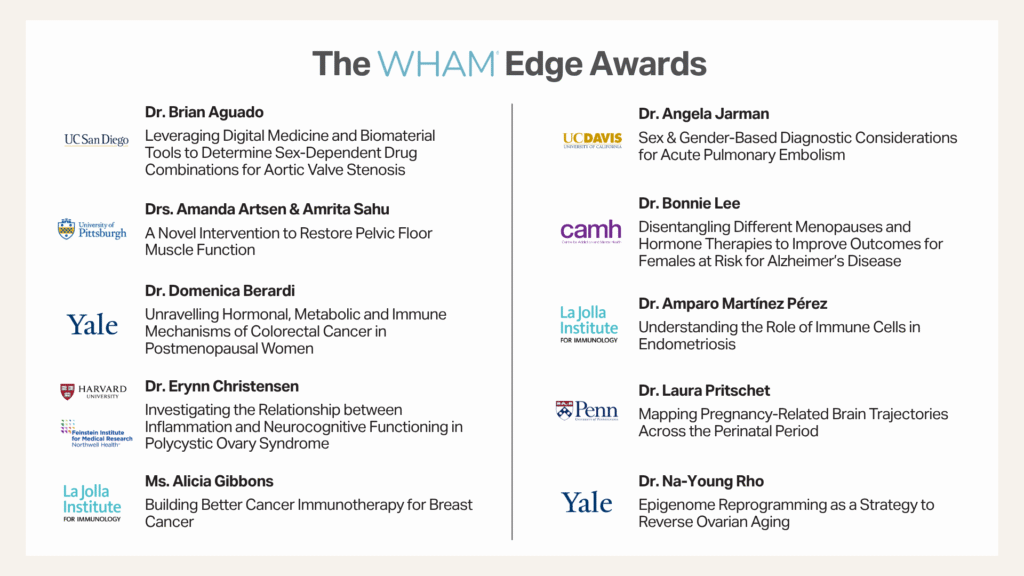
In 2025, WHAM received a record number of applications and raised $250,000 to fund 10 high-impact projects across the U.S. and Canada. Each project advances women’s heart health, brain health, autoimmune disease, or cancer, or explores novel approaches to conditions that uniquely affect women. Through these awards, WHAM is accelerating both basic and clinical research to uncover sex-based biological differences and drive innovation in women’s health.
2025 WHAM EDGE AWARDS RECIPIENTS

DR. BRIAN AGUADO
Assistant Professor of Bioengineering, University of California, San Diego
Leveraging Digital Medicine and Biomaterial Tools to Determine Sex-Dependent Drug Combinations for Aortic Valve Stenosis: Aortic valve stenosis (AVS) occurs when the heart’s main valve stiffens, limiting blood flow. It affects more than one in eight adults over 75, yet women are less likely to be diagnosed or receive surgery even with severe disease. Dr. Aguado will combine artificial intelligence-based tools with lab-grown heart models to find drug combinations that work best for women and men. Learn more.
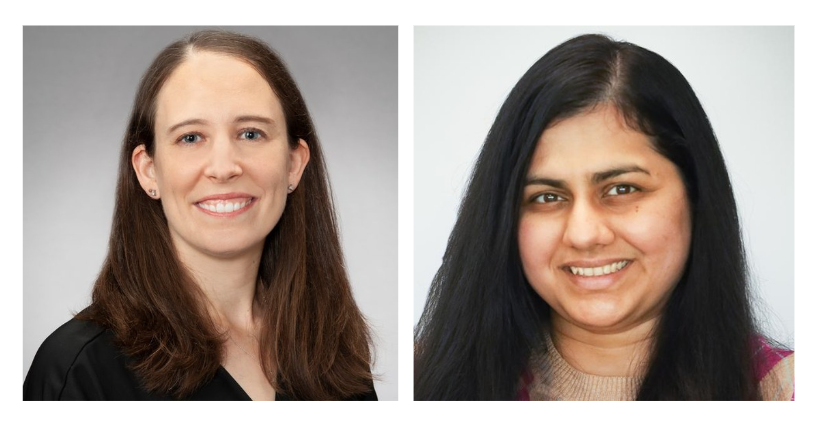
DR. AMANDA ARTSEN
Assistant Professor, Department of Obstetrics, Gynecology & Reproductive Sciences, University of Pittsburgh
DR. AMRITA SAHU
Assistant Professor, Department of Physical Medicine & Rehabilitation, University of Pittsburgh
A Novel Intervention to Restore Pelvic Floor Muscle Function: Pelvic organ prolapse (POP) can happens when weakened pelvic muscles cause organs like the bladder or uterus to shift out of place, often after childbirth or with age. It affects up to half of all women. Drs. Artsen and Sahu will study how childbirth injuries weaken these muscles and test whether a new vaginal hydrogel can help repair them. Learn more.

DR. DOMENICA BERARDI
Postdoctoral Researcher, Yale School of Public Health
Unravelling Hormonal, Metabolic and Immune Mechanisms of Colorectal Cancer in Postmenopausal Women: Colorectal cancer is a leading cause of cancer deaths worldwide. While men are diagnosed more often, postmenopausal women face increasing rates of a more dangerous type that forms on the right side of the colon. Dr. Berardi will study how estrogen may protect against this disease by testing how it affects female-derived cancer cells. Learn more.

DR. ERYNN CHRISTENSEN
Postdoctoral Researcher, The Feinstein Institutes for Medical Research, Northwell Health; Postdoctoral Fellow, Harvard University
Investigating the Relationship between Inflammation and Neurocognitive Functioning in Polycystic Ovary Syndrome: Polycystic Ovary Syndrome (PCOS) affects up to 20% of women and is the leading cause of infertility. It’s caused by higher levels of hormones which throws off the normal signals between the brain and ovaries and is increasingly linked to inflammation that may affect brain function. Dr. Christensen will study how inflammation across the menstrual cycle relates to cognitive functions like attention and memory in women with PCOS. Learn more.

MS. ALICIA GIBBONS
Doctoral Researcher, La Jolla Institute for Immunology
Building Better Cancer Immunotherapy for Breast Cancer: Triple-negative breast cancer (TNBC) is one of the most aggressive and difficult-to-treat cancers, especially among younger women and women of color. While new immune-based treatments offer promise, they don’t work for everyone and often cause harsh side effects. Ms. Gibbons will study whether a molecule called LPC 18:2 helps explain why patients respond differently to these therapies. Learn more.
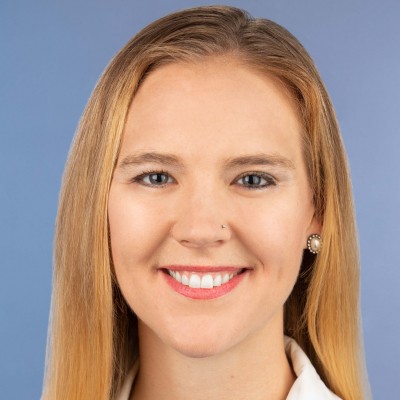
DR. ANGELA JARMAN
Associate Clinical Professor of Emergency Medicine, University of California, Davis
Sex & Gender-Based Diagnostic Considerations for Acute Pulmonary Embolism: Pulmonary embolism (PE), a blood clot in the lungs, is the third leading cause of heart related death in the U.S. Women are tested for PE more often than men yet are far less likely to be diagnosed. Dr. Jarman will study how men and women are evaluated for PE and whether sex-specific clues can improve testing accuracy. Learn more.
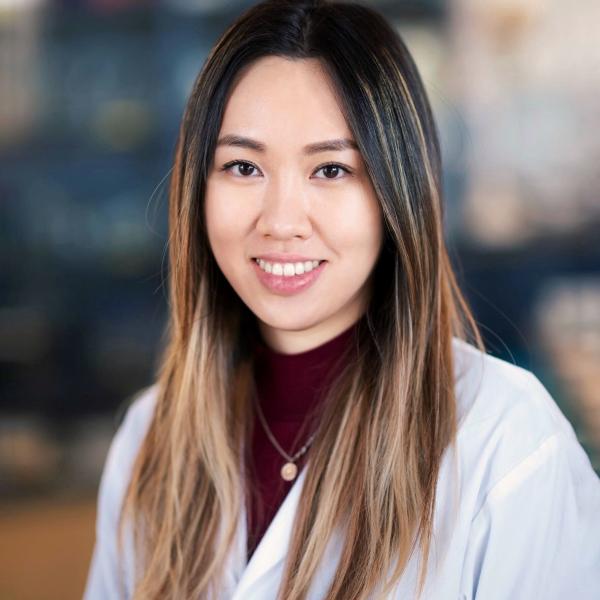
DR. BONNIE LEE
Postdoctoral Fellow, Centre for Addiction and Mental Health
Disentangling Different Menopauses and Hormone Therapies to Improve Outcomes for Females at Risk for Alzheimer’s Disease: Women make up two-thirds of all Alzheimer’s disease cases. A gene called APOE ε4 raises the risk for everyone, but women who carry it face a much higher chance of developing the disease—especially around menopause, when estrogen levels drop. Dr. Lee will study how different types of menopause and hormone therapies affect memory and brain health in female models of Alzheimer’s, both with and without the APOE ε4 gene. Learn more.
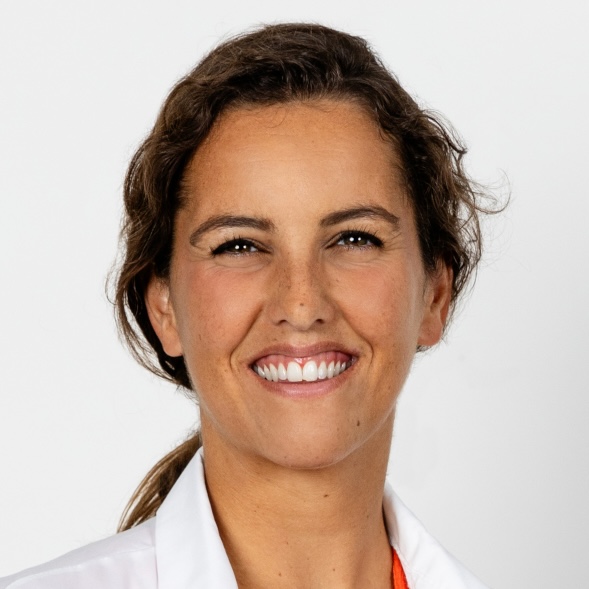
DR. AMPARO MARTÍNEZ PÉREZ
Postdoctoral Researcher, La Jolla Institute for Immunology
Understanding the Role of Immune Cells in Endometriosis: Endometriosis affects about one in ten women of reproductive age, causing pain, inflammation, and fertility problems when tissue similar to the uterine lining grows elsewhere in the body. Immune cells called T cells may be involved, but their role is still unclear. Dr. Martínez Pérez will study these cells in menstrual blood to see what they’re ‘attacking’ and how those attacks could play a role in endometriosis. Learn more.

DR. LAURA PRITSCHET
Postdoctoral Scholar, Department of Psychiatry, University of Pennsylvania
Mapping Pregnancy-Related Brain Trajectories Across the Perinatal Period: Pregnancy brings dramatic hormonal and physical changes for more than 140 million women each year, yet we still know little about how the brain changes during this time. Dr. Pritschet will analyze 25 years of existing brain scans linked to medical records from more than 5,000 women to map how the brain adapts through pregnancy and after birth. Learn more.

DR. NA-YOUNG RHO
Postdoctoral Associate, Yale School of Medicine
Epigenome Reprogramming as a Strategy to Reverse Ovarian Aging: As women’s ovaries age, fertility declines, miscarriage risk rises, and some women experience early menopause—raising the risk for bone loss, heart disease, and memory problems. Ovarian aging is not just about fertility; it’s a major health issue for millions of women. Dr. Rho will study chemical changes that impact how genes work, focusing on a gene called BRCA1, to identify early markers of ovarian aging. Then, using a gene-editing tool called CRISPR, she will explore whether these changes can be reversed. Learn more.